
Best Website to Learn Trading Free: A Checklist for Success
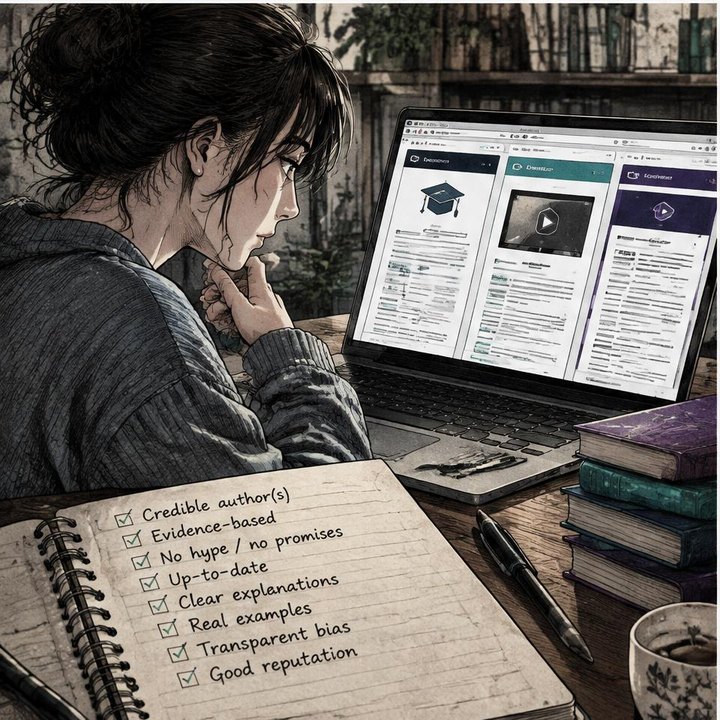
The best website to learn trading is one that teaches risk management, explains its methods, and gives you a clear way to practise without promising profits. This checklist helps beginners evaluate free trading education before committing money or trusting a coach. If you want to learn trading free, look for a structured learning path that builds understanding—not a collection of signals, profit screenshots, or “secret” strategies.
What a useful free trading course should teach
A free trading course should be a connected set of lessons, not just a library of videos. You should understand where to start, what each lesson adds, and how to test your understanding before moving on.
Good trading for beginners starts with market mechanics: how buyers and sellers interact, what order types do, and why the price you receive can differ from the price you expected. It should also explain the spread—the gap between buying and selling prices—and how fees affect results.
Next comes context. Economic announcements, company news, liquidity, and changing expectations can all influence markets. A chart pattern alone does not explain why price moves or whether a trade is worth considering.
Look for a curriculum that covers:
- Market basics: How the chosen market works, including its trading hours and relevant risks.
- Chart reading: Trends, ranges, support, resistance, and the limits of these concepts.
- Risk management: Position sizing, leverage, exit planning, and the possibility of losses beyond expectations.
- Practice and review: Historical examples, simulation, and a trading journal.
The goal is to become capable of evaluating a decision yourself, rather than depending on someone else’s next alert.
How to evaluate a trading education website
Much trading content doubles as a sales funnel. Selling a service does not automatically make education poor, but you should know when teaching ends and promotion begins.
Use these checks before signing up:
- Fundamentals before shortcuts: Does the provider explain market behaviour, or present chart patterns as magic?
- Risk before reward: Are losses, trading costs, and leverage discussed alongside potential opportunities?
- Transparent methodology: Can you identify the conditions behind an example, including what would invalidate it?
- Balanced examples: Does the material show failed setups and uncertain situations, not just clean winners?
- Clear commercial interests: Are paid upgrades, sponsorships, and broker referral relationships disclosed?
- No profit guarantees: Treat guaranteed trading profits as a scam warning, not a reason to enrol.
A free resource should also make its boundaries clear. Check which lessons are included and whether meaningful instruction disappears behind an unexpected paywall.
If you are searching for the best trading coach, apply the same standards. Teaching quality matters more than confidence or lifestyle marketing. A useful coach explains uncertainty, welcomes questions, and helps you review your reasoning. Profit screenshots alone cannot establish skill, consistent performance, or teaching ability.
What good teaching looks like on a real chart
Imagine opening a chart where price is approaching the prior day’s high. A weak lesson might say, “Buy the breakout.” A useful lesson slows down and explains what you can observe—and what remains unknown.
First, it identifies context. Is price trending upward or moving sideways? Has it repeatedly failed near this area? Is a scheduled announcement approaching that could cause abrupt movement?
Next, it defines the event. Price briefly moving above a level is not the same as remaining above it. A lesson should explain precisely what its method treats as a breakout, without claiming that definition guarantees success.
Finally, it discusses risk. What observation would contradict the trade idea? How would the distance to a planned exit affect position size? Could a gap or fast market make execution worse than expected? A stop order does not guarantee an exact exit price.
Indicators should support this explanation, not replace it. Someone searching for the best trading indicators needs to learn what each tool measures. A moving average summarises past prices; it does not know what happens next. Adding more indicators can repeat the same information rather than provide independent confirmation.
A worked example: reviewing a breakout without risking money
Consider a hypothetical chart where price has been moving below the prior day’s high. It then breaks above that level. Use this as a paper-trading exercise, not a recommendation to enter a position.
Before revealing the next part of the chart, write down what is visible. Describe the earlier trend, the level being tested, and whether price is moving steadily or erratically. Separate observations from assumptions: “price crossed the high” is observable; “buyers will keep pushing higher” is a prediction.
Define the practice setup in advance. For example, the exercise might require price to remain above the old high and then revisit it without immediately falling back below. Record what would invalidate that interpretation and where a hypothetical exit would sit.
Choose a simulated position size consistent with your practice risk limit. Include estimated trading costs rather than treating every chart entry as frictionless.
Now reveal what happens next. Suppose price slips back below the old high and reaches the planned exit. The lesson is not that all breakouts fail. Ask whether the example met your rules, whether the risk was defined beforehand, and whether you followed the plan.
A losing simulation can demonstrate good process. A profitable simulation can still contain poor decisions. Review both.
Common mistakes when you learn to trade online
The biggest mistake is confusing access to information with progress. Watching lessons endlessly can feel productive while leaving you unable to explain a basic trade idea.
Other common traps include:
- Switching strategies after every loss: This prevents meaningful review of a consistent method.
- Copying signals without context: You may not know the provider’s timeframe, exit rules, or risk exposure.
- Ignoring costs: Frequent trading can look very different once spreads, fees, and execution differences are considered.
- Trusting hindsight examples: A setup that looks obvious after the move may have been ambiguous beforehand.
- Treating simulation as proof: Paper trading helps practise mechanics but cannot fully reproduce execution or emotional pressure.
Be equally careful with AI trading tools. They can help organise notes, explain terminology, or generate questions for study. They can also produce incorrect explanations, use outdated information, or present assumptions as facts. Verify their output against reliable market information. An AI-generated signal is not evidence of an edge.
Objective market analysis means considering reasons an idea might fail, not just collecting reasons to believe it.
Your practice checklist and a structured starting point
Before committing to a learning platform, complete this short checklist:
- Read a beginner lesson and explain its main idea in your own words.
- Find its discussion of risk, costs, and failed setups.
- Apply its method to a historical chart without looking ahead.
- Journal your observations, rules, uncertainty, and outcome.
- Check pricing, promotional claims, and commercial relationships.
We built Trade Feeld’s free Seekers plan to provide a structured, objective, and realistic starting point. It offers a framework for learning, not a promise of riches. Reading, practice, and journaling should build your own understanding rather than dependence on a guru. This is education only, not financial advice.
For ongoing education and community insights, explore Trade Feeld, @tradefeeld on X, @akylles on X, @tradicators on X, Instagram, YouTube, and LinkedIn. Apply the same checklist to every resource, including ours.
Frequently asked questions
Sources & further reading
Educational content only, not financial advice. Trading involves risk of loss.
Trade these setups live
Get the same signals our research desk uses — entries, stops, and targets in real time.
Gain instant accessKeep reading
Start Trading from 0: The Complete First-Week Plan
Learn how to start trading from scratch with this structured 7-day action plan covering platforms, charts, and your first demo trades.
Trading from 0 to Hero: The Realistic Roadmap
Discover the stages of a trader's evolution, from the initial 'unconscious incompetence' to becoming a consistently profitable market participant.
Comments(0)
Discuss the article and share your tips.