
Inflation & CPI Explained
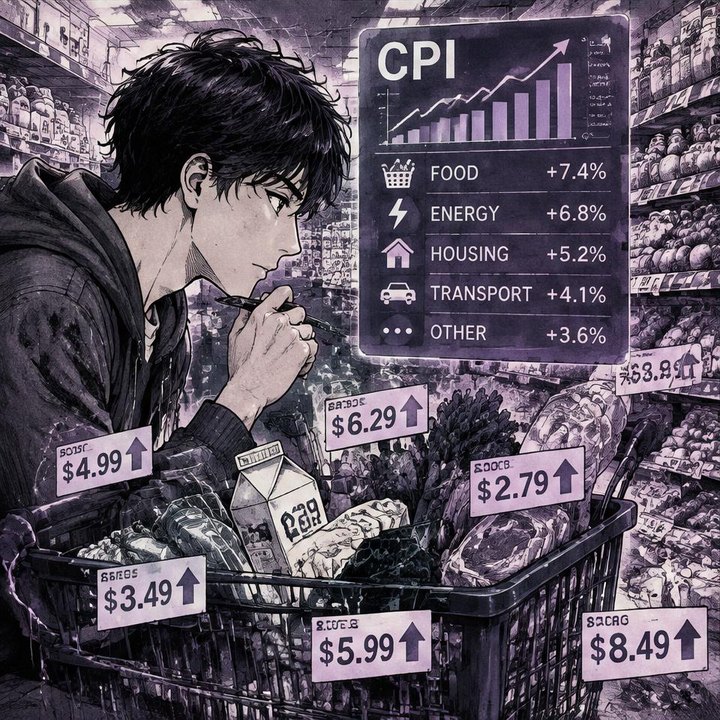
Inflation is a broad rise in the prices of goods and services over time, which reduces what your money can buy. The Consumer Price Index, or CPI, tracks those price changes through a representative shopping basket. Understanding inflation and CPI helps beginner traders make sense of interest-rate expectations and movements in bonds, gold, and forex, especially when economic releases trigger sudden market swings.
What is inflation, and why does it matter?
Inflation measures the rate at which prices increase across an economy. A more expensive loaf of bread alone does not establish broad inflation. Prices must rise across a wider range of goods and services, although they rarely move together at the same speed.
Inflation can feel like a silent killer of purchasing power. If your income stays unchanged while everyday costs rise, you can afford less. It also changes the purchasing power of cash savings and the future payments investors receive from bonds.
Several forces can contribute:
- Stronger demand: Households and businesses want to buy more than suppliers can readily provide.
- Higher production costs: Energy, materials, transport, or wages become more expensive.
- Supply disruptions: Shortages make goods harder to obtain.
Slower inflation does not necessarily mean cheaper prices. Disinflation means prices are rising more slowly; deflation means the overall price level is falling. This distinction matters when a “cooler” inflation report still shows rising living costs.
What is CPI, and how does it measure inflation?
The Consumer Price Index measures changes in the price of a representative basket of goods and services purchased by consumers. That basket includes categories such as food, housing, transport, and healthcare.
Each category receives a weight reflecting its importance in household spending. A price change in a heavily weighted category therefore matters more to the index than an equivalent change in a smaller category.
If the basket costs more than it did a year earlier, the annual CPI change indicates inflation. Traders commonly examine two comparisons:
- Month-on-month: How prices changed from the previous month.
- Year-on-year: How prices changed from the same month a year earlier.
Monthly readings help reveal recent momentum. Annual readings offer a longer perspective, but can also shift because an unusually strong or weak month drops out of the comparison. This is called a base effect.
Headline CPI includes the full basket. Core CPI commonly excludes food and energy because their prices can be volatile. Core inflation is not a claim that those essentials do not matter; it helps analysts assess underlying pressures.
CPI is one of the most widely followed inflation gauges, but your personal cost increases may differ from the index because your spending differs from the representative basket.
Why central banks make CPI a market-moving release
Central banks seek price stability, often alongside other responsibilities such as employment. If inflation is too persistent, they may raise interest rates or keep them elevated to cool demand.
Higher rates tend to make mortgages, consumer loans, and business borrowing more expensive. That can reduce spending and investment, easing pressure on prices over time. The process is neither immediate nor guaranteed.
High inflation therefore often leads to interest-rate hikes, but not automatically. Policymakers also consider growth, employment, credit conditions, and whether inflation reflects temporary disruptions or sustained pressure. Some central banks prefer inflation measures other than CPI.
This policy connection explains why inflation can dominate the trading landscape:
- Bonds: Higher expected interest rates generally push existing fixed-rate bond prices lower and yields higher. Longer-maturity bonds can be particularly sensitive.
- Forex: A currency may strengthen if traders expect its central bank to maintain higher rates relative to other countries.
- Gold: Gold pays no interest. Higher inflation-adjusted yields can make interest-paying assets more attractive by comparison, putting pressure on gold.
These are relationships, not trading rules. Gold can also attract demand during uncertainty, while weak growth can complicate a currency’s response to high inflation.
Reading a CPI release on a real chart: a worked example
On a live chart, CPI often appears as a sudden expansion in candle size around the release. Trading activity can increase, spreads may widen, and price can cross a familiar level before reversing.
The key question is not simply whether inflation is high. It is how the report compares with expectations, including its underlying details.
Imagine traders expect inflation to ease, but the release shows more persistent price pressure than anticipated. Markets begin pricing in the possibility that the central bank will keep rates high for longer.
Government bond yields rise and existing bond prices fall. The domestic currency strengthens as traders reassess its expected rate advantage. Gold weakens as yields and the currency rise.
On the currency chart, price breaks above the prior day’s high. Rather than treating that first move as confirmation, a learner watches what follows. Does price remain above the level? Does a pullback hold, or does price quickly return to its earlier range?
If the breakout fails while yields also retreat, the initial interpretation may be losing support. Perhaps traders noticed softer details elsewhere in the report, or much of the inflation risk was already priced in.
This is a hypothetical reading exercise, not a forecast or trade recommendation. It illustrates how the economic surprise, related markets, and chart behaviour fit together.
Common mistakes when learning how to trade inflation
For anyone studying how to trade inflation, the biggest mistake is assuming a release produces a predictable direction.
Other common errors include:
- Trading the headline alone: Core readings and individual categories may tell a different story.
- Ignoring expectations: Inflation can fall but still exceed forecasts, producing a reaction that surprises beginners.
- Treating the first candle as the final verdict: Automated orders and rapid repositioning can create sharp reversals.
- Ignoring execution risk: A stop order does not guarantee its requested execution price during fast moves. Spreads and slippage can increase costs.
- Assuming every inflation report matters equally: Markets may focus more on growth, employment, or financial stress at different points.
Trading for beginners should prioritise understanding these conditions rather than trying to capture every announcement.
A short CPI practice checklist
Use historical charts or a simulation to practise without risking capital:
- Check the release time, reporting country, and whether the figures are headline or core.
- Record the forecast and previous reading before viewing the result.
- Mark the chart’s recent range and prior day’s high and low.
- Compare the release with expectations, then observe bonds, the currency, and gold.
- Note the initial reaction and whether it persists after the first burst of activity.
- Write down competing explanations instead of forcing a single story.
Keep the exercise educational. A good explanation after the event does not prove that the move was predictable beforehand.
Keep learning with Trade Feeld
If you want to learn trading free, start with structured lessons and repeatable observation. The best website to learn trading is one that explains uncertainty and risk clearly; the best trading coach should teach a process rather than promise outcomes. Explore the free trading course as a next step.
Continue exploring at Trade Feeld, or follow @tradefeeld on X, @akylles on X, @tradicators on X, Instagram, YouTube, and LinkedIn.
This article is for education only, not financial advice.
Frequently asked questions
Sources & further reading
Educational content only, not financial advice. Trading involves risk of loss.
Trade these setups live
Get the same signals our research desk uses — entries, stops, and targets in real time.
Gain instant access
Comments(0)
Discuss the article and share your tips.