How to Set Up Your Trading Desk (Monitors, Hardware, Layout)
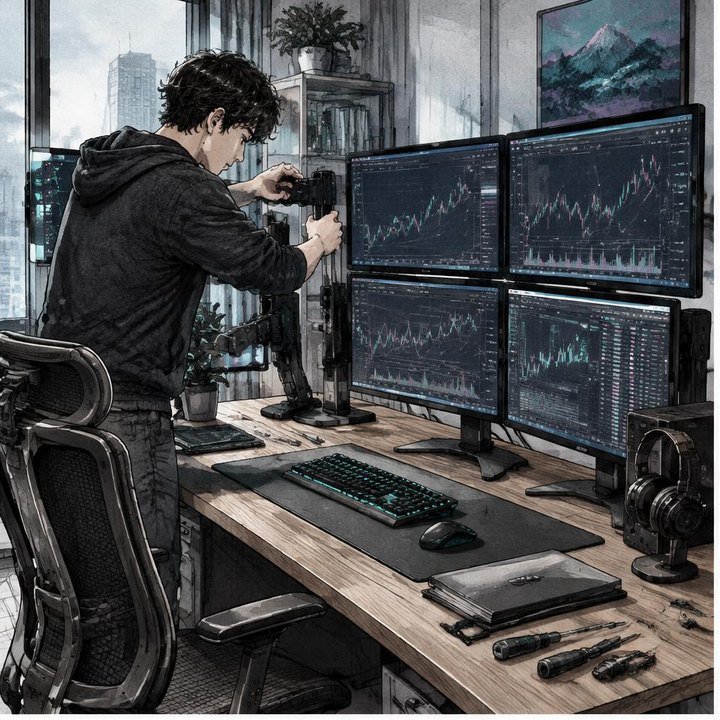
Your trading environment is your cockpit. Just like a professional pilot needs a clean, efficient, and well-organized dashboard to navigate, you need a trading desk setup that minimizes friction and maximizes your ability to process information. Many beginners focus on the "cool" factor—multiple monitors and RGB lighting—but the true goal of a professional desk is to support your health, your focus, and your speed of execution.
The ergonomics of high-performance trading
Trading involves long hours of intense focus. If your desk is poorly designed, physical fatigue will lead to mental fatigue, which leads to bad trading decisions. - Chair: Invest in a high-quality ergonomic chair. Your back and neck are your most valuable assets besides your capital. - Monitor Height: Your primary monitor should be at eye level. Looking down or up for hours causes significant strain. - Lighting: Avoid glare on your screens. Natural light is great, but ensure it doesn't wash out your charts during the morning or afternoon sessions.
A clean workspace leads to a clean mind. By following the principles we teach in our 1-on-1 Mastery program, you learn that discipline starts with how you organize your physical surroundings.
Choosing the right hardware
Speed matters, but reliability is paramount. You don't need the most expensive gaming PC, but you do need hardware that can handle modern charting platforms like the Tradefeeld Terminal without lagging. - Processor and RAM: Charting tools and multiple browser tabs are memory-intensive. Aim for at least 16GB (ideally 32GB) of RAM and a modern multi-core processor. - Internet Connection: A wired Ethernet connection is always superior to Wi-Fi for trading. Lag during a fast-moving market can cost you hundreds or thousands of dollars in slippage. - Uninterruptible Power Supply (UPS): If you live in an area with occasional power flickers, a UPS can save your equipment and give you time to close positions if the power goes out.
Designing your multi-monitor workflow
The goal of multiple monitors is to separate "types" of information so your brain doesn't have to constantly switch contexts. A common and effective 3-monitor layout looks like this: 1. Center Monitor: Your main execution timeframe. This is the chart you are actively trading. 2. Left Monitor: Higher timeframes and market internals. This gives you the context (the macro view). 3. Right Monitor: News feeds, economic calendars, and your trading journal.
By keeping your execution space separate from your research space, you reduce the chance of making impulsive trades based on a single news headline. You are building a system that encourages you to follow your trading plan.
The psychological impact of your desk
Finally, remember that your desk is a dedicated space for work. When you sit down, your brain should know it's time to perform. Keep distractions like phones, gaming consoles, or non-trading related paperwork away from your immediate area. A professional desk is a symbol of your commitment to the craft. It tells you and everyone else that you are here to trade, not to play.
Keep learning with Trade Feeld
For deeper insights into how these concepts apply to your daily trading, visit Trade Feeld, follow @tradefeeld on X, @akylles on X, @tradicators on X, Instagram, YouTube, and LinkedIn.
How to apply Set Up Your Trading Desk (Monitors, Hardware, in practice
The useful question is not whether How to Set Up Your Trading Desk (Monitors, Hardware, Layout) sounds convincing. It is whether you can turn the idea into a decision that another careful trader could understand and repeat. A useful trading desk reduces friction, protects attention, and makes the same preparation process easy to repeat. Begin with this principle: Prioritize ergonomics and cable management to reduce mental clutter. Then translate it into a chart observation, a written rule, and a clear condition that would prove your interpretation wrong.
Use the market you follow as a study list, not as a promise that the same rule works identically everywhere. Market hours, liquidity, volatility, transaction costs, and news sensitivity can change the result. Open several historical examples and include quiet periods, fast moves, failed signals, and awkward conditions. Looking only at attractive examples teaches recognition after the fact; looking at failures teaches decision-making before the outcome is known.
A repeatable Set Up Your Trading Desk (Monitors, Hardware, workflow
Build one watchlist, one clean chart layout, one calendar routine, and one journal before adding specialist tools. Keep the workflow deliberately small. A beginner needs a process that survives distraction and uncertainty more than a complicated dashboard. Before each example, write what you expect to observe. Afterward, save the chart and record what actually happened. This prevents memory from quietly rewriting the original idea.
For every practice example, answer these questions: - What is the wider market context and relevant timeframe? - What exact condition makes the setup valid? - Where is the idea objectively invalidated? - How much could be lost if the invalidation is reached? - Is the potential reward reasonable after spread, fees, and slippage? - Is scheduled news likely to change the conditions? - What will be recorded after the trade or observation ends?
The answer should be short enough to read before acting. If a rule needs a paragraph of exceptions, it is probably not ready. Invest in reliable hardware and a stable internet connection first. A checklist does not create an edge by itself, but it makes your decisions observable. Once decisions are observable, they can be reviewed and improved.
Set Up Your Trading Desk (Monitors, Hardware,: worked study exercise
Choose one liquid instrument from the market you follow and open a chart without placing a trade. Mark the relevant session, recent swing high and low, and any scheduled event that could affect price. Apply the central idea from this article and capture a screenshot before the next move unfolds. Add a sentence explaining your expectation and another sentence defining invalidation.
Repeat this process across at least three different conditions: a directional trend, a sideways range, and a volatile news-driven period. Do not change the rule between examples. The goal is to discover where the idea is useful, where it becomes ambiguous, and where it should be ignored. Compare outcomes in risk units rather than money so that examples with different prices or account sizes remain comparable.
This is also where a trading journal becomes valuable. Record date, instrument, timeframe, context, setup, trigger, planned risk, outcome, and one lesson. Screenshots matter because they preserve information that a final profit-and-loss number cannot show. A good review asks whether the process was followed; a lucky result from a broken process is not a good trade.
Risk management for Set Up Your Trading Desk (Monitors, Hardware,
No article, coach, indicator, or AI trading tool can remove uncertainty. Decide the maximum acceptable loss before considering the possible gain. Position size should be calculated from the distance between entry and invalidation, not from confidence or excitement. When volatility expands, the same fixed position may create much more risk, so size usually needs to contract.
Avoid the most common error in this topic: Collecting screens, subscriptions, and indicators without defining which decision each tool improves. If the invalidation condition occurs, close or reassess according to the written plan. Moving the invalidation simply to avoid admitting an error changes a controlled decision into an uncontrolled one. Also consider correlated exposure: several positions driven by the same currency, index, sector, or crypto cycle may behave like one large trade.
Use multi-monitor setups to separate news, charts, and execution platforms. Evaluate a sequence of decisions rather than one win or loss. A method can lose while being executed correctly, and a bad decision can make money by chance. That distinction is central to sustainable learning.
Tools and AI trading tools for Set Up Your Trading Desk (Monitors, Hardware,
Charts, screeners, economic calendars, journals, and AI trading tools can reduce manual work, but each tool needs a defined purpose. Ask what information it uses, how current that information is, what assumptions it makes, and what happens when data is delayed or missing. A Free AI Indicator, AI trading robot, or bot-trading product should never be trusted merely because it uses AI language. Look for transparent inputs, realistic costs, test periods that include different market conditions, and clear risk controls.
Use the Trade Feeld Terminal to observe live market context, events, news, and sentiment together. Continue through the free trading course if you want to learn trading free in a structured order. The aim is not to collect more signals; it is to improve the quality of the decision made before risk is taken.
Verify Set Up Your Trading Desk (Monitors, Hardware, sources and keep learning free
Use the sources listed after this article as starting points and prefer primary material such as regulator guidance, official economic releases, exchange documentation, and company filings. Check publication dates and definitions because market rules, products, and data methods change. Search summaries can help you locate information, but they should not replace the original source.
The best website to learn trading is the one that helps you test ideas honestly, exposes uncertainty, and keeps education separate from promises of profit. Trade Feeld publishes practical education for trading beginners and developing traders, while the Pro library keeps the newest research and advanced setups easy to find. Continue with the next article in the learning path, or use the Pro tab to read the latest material first.
Follow Trade Feeld
Frequently asked questions
Sources & further reading
Educational content only, not financial advice. Trading involves risk of loss.
Trade these setups live
Get the same signals our research desk uses — entries, stops, and targets in real time.
Gain instant accessKeep reading
TradingView and 4 Other Charting Tools Compared
Compare the most popular charting platforms to find the best fit for your trading style and technical analysis needs.
How to Choose a Broker (Regulation, Fees, Platforms)
Learn the essential criteria for selecting a reliable, regulated broker to ensure your capital is safe and your trading costs are low.
Comments(0)
Discuss the article and share your tips.