AI Indicators vs Traditional Indicators: What Actually Changes
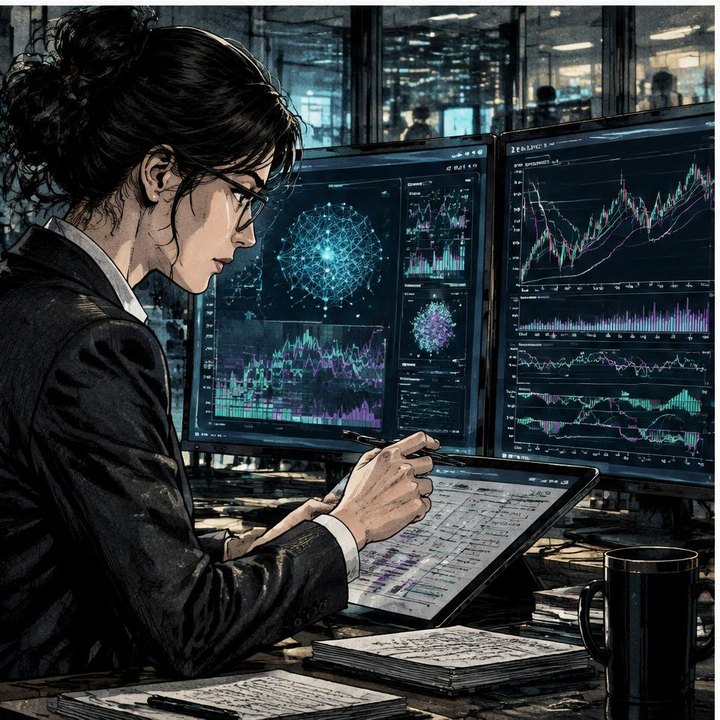
AI indicators vs traditional indicators is a comparison of outputs, not a contest between smart and outdated tools. RSI and MACD summarize observed market data; a properly trained AI model can estimate the probability of a defined future outcome. Both depend on historical information, and neither knows what happens next. This distinction helps intermediate crypto, stock, and forex traders judge signals, test claims, and separate useful forecasting from marketing.
What actually changes: description versus estimation
RSI measures recent upward and downward price movement. MACD compares moving averages. Bollinger Bands describe price relative to a moving average and recent dispersion. Stochastics locate the close within a recent trading range.
These traditional indicators transform historical prices, including the latest observation. Their lag is not necessarily a defect: smoothing can help traders distinguish persistent movement from noise. They provide consistent descriptions of momentum, trend, or location.
An AI indicator adds a learned mapping between market conditions and a specified outcome. Instead of reporting that momentum has strengthened, it might estimate whether price will reach an upper barrier before a lower barrier within a defined window.
The meaningful change is the prediction target, not the AI label. Traditional indicators can support predictive strategies, and their readings can be mapped to probabilities through testing. Conversely, an AI product may output a classification, ranking, or expected return rather than a probability.
“Traditional indicators describe; AI indicators predict” is a useful starting point, but too absolute as a final explanation.
What an AI indicator is—and what its number means
An AI indicator is a model, potentially a gradient-boosted tree, a small transformer, or an ensemble, that processes market features. Inputs might include price action, volatility, order-flow imbalance, funding, and cross-asset relationships. RSI and MACD can themselves become inputs.
The model learns relationships in training data and applies them to new observations. Before interpreting its output, establish:
- Target: What event or quantity is being predicted?
- Horizon: Over how many bars, or what elapsed time?
- Availability: Were all inputs observable when the signal appeared?
- Output: Is the reading a probability, expected return, or arbitrary score?
A probability and an expected edge are not interchangeable. A model can correctly anticipate frequent small advances while missing occasional large declines that overwhelm them.
Calibration addresses another question: do predicted probabilities match observed frequencies? For a calibrated model, events assigned a 0.7 probability should occur roughly 70% of the time across a sufficiently large, relevant sample. That does not guarantee any individual result.
A useful assessment also asks whether the model separates better opportunities from worse ones and improves on a simple baseline. Calibration alone does not establish profitability after costs.
How the difference appears on a real chart
Consider price approaching the prior day’s high. RSI is elevated, MACD is positive, and Bollinger Bands are widening. These observations describe strengthening momentum and expanding dispersion. They do not independently establish whether the breakout will continue.
An AI model might combine those readings with trading volume, volatility, and the wider market’s direction. Where reliable data exists, it could also consider order-flow imbalance or derivatives funding.
The instrument matters. Crypto trades continuously, and funding applies to particular derivatives rather than every crypto market. Stocks have sessions, opening gaps, and corporate actions. Spot forex volume and order-flow information depend on the venue or provider; they are not a complete view of a centralized market.
A model trained on one feed should not automatically be trusted on another.
Timing matters too. If the model requires a completed candle, a signal shown before that close may change. Historical charts must not present finalized signals as though traders could have acted on them earlier.
Compare both approaches at the same decision time, using the same data availability, execution assumptions, and holding horizon.
Worked example: evaluating a breakout without hindsight
Suppose price breaks above the prior day’s high after trading in a narrow range. The breakout candle closes above that level, while momentum indicators strengthen.
A traditional rules-based setup might require the close above resistance and confirmation from MACD. Its rules establish an entry condition, an invalidation condition, and an exit method before testing begins.
An AI-assisted version might keep those rules but add a probability filter. Its target could be whether price reaches a predefined upper barrier before a lower barrier within the next specified number of bars. Those barriers and the horizon must be established beforehand.
Now imagine the model gives an uncertain reading because similar breakouts have behaved inconsistently under the current volatility conditions. The AI-assisted process skips the setup. If price subsequently rallies, that missed move does not prove the filter failed.
Alternatively, the model may favor continuation and the breakout may immediately reverse. One loss does not establish that the model is useless.
The comparison requires a sequence of unseen opportunities:
- Did the filter improve results relative to the original rules?
- Did fewer signals reduce exposure while also removing useful opportunities?
- Did spreads, fees, and slippage erase the apparent improvement?
- Did performance persist through trending, falling, and sideways conditions?
The aim is to test incremental value, not collect impressive chart screenshots. This is an educational testing framework, not a recommendation to trade breakouts.
Where the hype—and common mistakes—begin
Some products marketed as “AI Trading Robots” are conventional rules wrapped in new branding. But missing documentation does not prove that no model exists. It means the buyer lacks evidence to evaluate it.
Request a dated calibration curve for probability outputs, input disclosures, and out-of-sample results spanning different regimes. Feature-importance information can help, although it does not establish causation or explain every prediction.
Watch for leakage, repeated tuning against the test set, unrealistic fills, and results dependent on a few exceptional trades. Monthly retraining is not automatically better: updates need validation and version tracking.
Free products deserve the same scrutiny as paid ones. Serious validation requires resources, but price is not evidence of quality. Free tools can be useful; expensive subscriptions can be weak.
Trade Feeld’s stated Indicator Suite approach blends classical analysis with a calibrated probability layer trained on six years of tick data across crypto, equities, and FX. Its stated practices include quarterly calibration publication, monthly retraining, feature documentation, and withholding signals when uncertainty is high. Treat these as claims to verify against current documentation, not substitutes for testing. Silence reduces participation; it does not guarantee safety.
A short practice checklist
Whether comparing AI trading tools or searching for the best trading indicators, use a repeatable process:
- Record the target, horizon, inputs, and signal timestamp.
- Build a simple traditional-indicator baseline.
- Separate training, validation, and untouched test periods chronologically.
- Include realistic costs and check results across market regimes.
- Review calibration, missed opportunities, losing sequences, and model updates.
- Paper-test forward before considering any use with capital.
For readers moving beyond trading for beginners, the free trading course offers a starting point for structured study.
If your search begins with “learn trading free,” apply this same evidence standard. The best website to learn trading should teach reproducible testing; the best trading coach should explain uncertainty rather than promise accuracy.
AI changes how a signal is estimated. It does not remove execution risk, uncertainty, or the need for independent validation.
Follow Trade Feeld
Educational content only, not financial advice. Trading involves risk of loss.
Trade these setups live
Get the same signals our research desk uses — entries, stops, and targets in real time.
Gain instant accessKeep reading
Secret AI Trading Technical Indicators: What Pros Actually Use
Discover if there's such thing as a 'secret' AI indicator and how professional traders actually use machine learning in their technical analysis.
Best Trading Indicators for Gold
Learn which technical indicators work best for trading Gold, focusing on its unique volatility and relationship with the dollar.
Comments(0)
Discuss the article and share your tips.