AI Trading Robot: A Realistic Guide to Automated Execution
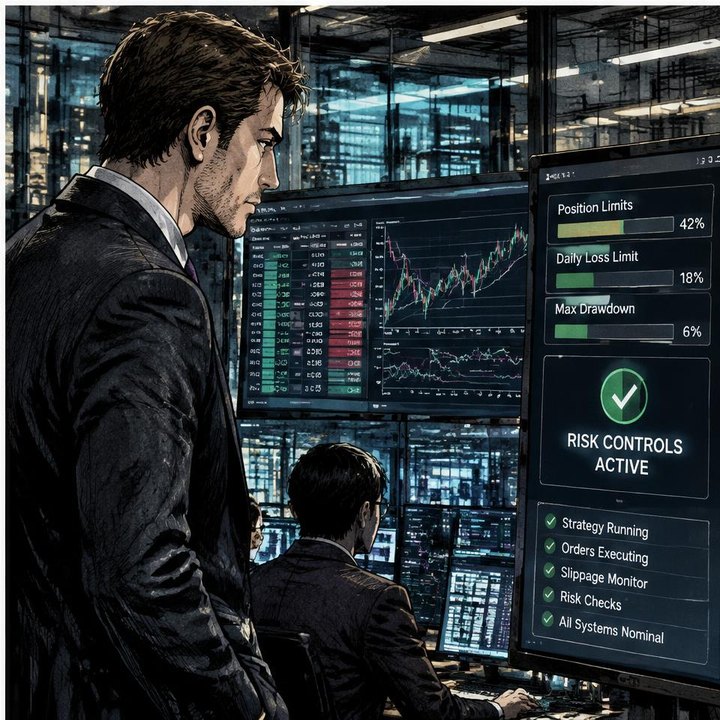
An AI Trading Robot is software that uses a learned model to make trading decisions and automate execution; it is not a reliable shortcut to profits. Its practical value is repeatable execution, consistent sizing, and monitoring within defined limits. This guide helps experienced discretionary traders and system evaluators understand what automation can control, where it breaks, and what evidence to demand before granting trading access.
What an AI Trading Robot is—and is not
An AI Trading Robot decides, sizes, and executes trades without a human pressing the button for each order. At least one decision—entry timing, sizing, exit management, or risk throttling—comes from a learned model rather than exclusively hardcoded rules.
That distinction matters. A script that buys a moving-average crossover is automated, but not necessarily AI. A model that estimates whether a breakout will follow through, then passes that estimate to an execution engine, adds a learned component.
Separate the system into three layers:
- Signal: Estimates an opportunity from specified inputs.
- Risk: Determines whether trading is allowed and how much exposure is acceptable.
- Execution: Submits, tracks, changes, and cancels orders.
The model should not override hard risk constraints. Better predictions do not excuse uncontrolled exposure.
Automation is not a money printer or autonomous wealth. Its defensible value is doing a defined task repeatedly without fatigue or emotional improvisation. Whether that task has a tradable edge is a separate question.
How automation works on a real chart
Consider a liquid market approaching the prior day’s high. A discretionary trader sees a possible breakout. An automated system needs explicit definitions: which trading session defines that high, whether a completed bar must close above it, and which data source supplies the price.
The model might evaluate trend, volatility, volume, and spread to estimate whether conditions support continuation. A rules-based gate then checks market hours, data freshness, existing exposure, and available account capacity.
If the trade qualifies, the sizing engine uses the proposed entry, stop distance, instrument contract value, and configured risk budget. The execution engine chooses an order type, submits it, checks acknowledgment, and reconciles fills with the account.
This is where AI Bots offer genuine advantages:
- Speed: Software can react and submit orders faster than manual clicking. Fill speed still depends on connectivity, venue rules, liquidity, and queue position.
- Discipline: A correctly constrained bot does not widen a stop out of frustration, add to a loser outside its rules, or skip a valid setup after losses.
- Coverage: It can monitor many markets and timeframes, subject to data access and computing limits.
- Sizing consistency: It applies a configured risk envelope rather than changing size with conviction.
Speed alone is not an edge. A faster order can simply buy an unfavorable price sooner.
Worked example: a breakout with controlled execution
Suppose price breaks above the prior day’s high after consolidating beneath it. The model classifies conditions as supportive of continuation. The strategy requires confirmation from a completed bar, so a brief intrabar spike is insufficient.
The intended stop sits below the breakout structure. Before sending an order, the system calculates position size from that stop distance and its risk budget, then checks whether correlated positions already consume the available exposure allowance.
Now the spread widens. The execution policy rejects an unrestricted market order and instead submits a price-limited order within its allowed tolerance. This trades certainty of execution for price control: the order may not fill.
Only part of the order fills. The bot records the actual quantity, establishes protection for that exposure, and cancels the remainder when the entry window expires. It must size exit orders to the filled position, not the originally requested quantity.
Price then falls back into the range. The exit rule triggers, and the system reconciles the resulting fill against the broker’s position record.
The lesson is not that this breakout works. It is that a complete trading process defines rejected entries, partial fills, cancellations, and failed trades—not merely an attractive chart signal.
Where AI Bots fail—and what traders misunderstand
Regime change exposes models trained on narrow conditions. A trend-following model can struggle in chop; a mean-reversion model can repeatedly oppose a persistent move. Regime detection and routing between sub-models may improve robustness, but regime classifications are themselves fallible.
Extreme events can exceed anything represented in training data. Hard exposure limits, order-size limits, and shutdown controls must operate independently of model confidence. Stops and loss caps cannot guarantee a maximum realized loss through gaps, halted markets, or unavailable liquidity.
Unrealistic fills make weak strategies look strong. Midpoint execution assumptions ignore spreads, queue position, rejected orders, and market impact. Backtests must account for commissions, applicable financing costs, and plausible execution friction.
Over-optimization selects rules that fit one particular past. Repeatedly inspecting a holdout dataset effectively turns it into training data. Time-ordered validation and genuinely untouched tests help, but do not establish future profitability.
Operational failures are equally important. Stale feeds, duplicate orders, expired credentials, and lost connections can turn a sensible strategy into unintended exposure. Recovery requires position reconciliation, not blindly restarting the program.
Finally, combining the best trading indicators does not automatically create an edge. Several indicators may describe the same price behavior. AI trading tools should demonstrate incremental value after costs, not merely produce sophisticated-looking scores.
What to verify before connecting an API key
Demand at least 90 days of forward-tested results with real fills, fees, and slippage. Treat that as an initial screening threshold, not proof of robustness. Simulated forward tests are useful, but are not equivalent to live execution.
Ask for the following:
- Drawdown evidence: The maximum observed drawdown, when it occurred, whether it includes unrealized losses, and how long recovery took.
- Exposure context: Markets traded, leverage, concentration, holding periods, and capital assumptions.
- Enforceable controls: User-configurable daily, weekly, and account-level loss caps, plus an explanation of what happens when each triggers.
- Permission boundaries: Read-only keys for monitoring; narrowly scoped trading permissions only when execution is required. Withdrawal permissions are never necessary.
- Failure procedures: Behavior during disconnections, stale data, rejected stops, partial fills, and restarts.
- Incident transparency: Reports explaining failures, their impact, and corrective action. A claimed spotless history deserves scrutiny, although an absence of reports alone proves nothing.
Check whether a shutdown cancels working orders, prevents new entries, or also attempts to flatten positions. Those are different actions with different risks. Use separate credentials, supported access restrictions, and a tested revocation procedure.
A short practice checklist—and the Trade Feeld stance
Before deploying capital:
- Write the complete entry, sizing, exit, and shutdown logic in plain English.
- Replay a trending session, a choppy session, and a disrupted session.
- Test partial fills, stale data, and a connection loss.
- Compare intended orders with actual executions and account positions.
- Confirm who receives alerts and who can intervene.
Trade Feeld publishes signals, not autonomous execution: entry, stop, target, and size, with you remaining in the loop. Our caution reflects promising AI Bots failing during regime changes. Any future autonomous offering would require explicit guardrails and calibration data presented first.
Our free weekly community workshop is an entry point for studying automation. If you want to learn trading free, start with the free trading course. Whether evaluating the best website to learn trading or the best trading coach, prioritize transparent reasoning and risk instruction over promises. Trading for beginners should build those foundations before delegating execution.
This article is education only, not financial advice.
Follow Trade Feeld
Educational content only, not financial advice. Trading involves risk of loss.
Trade these setups live
Get the same signals our research desk uses — entries, stops, and targets in real time.
Gain instant accessKeep reading
Secret AI Trading Technical Indicators: What Pros Actually Use
Discover if there's such thing as a 'secret' AI indicator and how professional traders actually use machine learning in their technical analysis.
Best Trading Indicators for Gold
Learn which technical indicators work best for trading Gold, focusing on its unique volatility and relationship with the dollar.
Comments(0)
Discuss the article and share your tips.