
Trading Psychology for Beginners: Fear, FOMO and Discipline
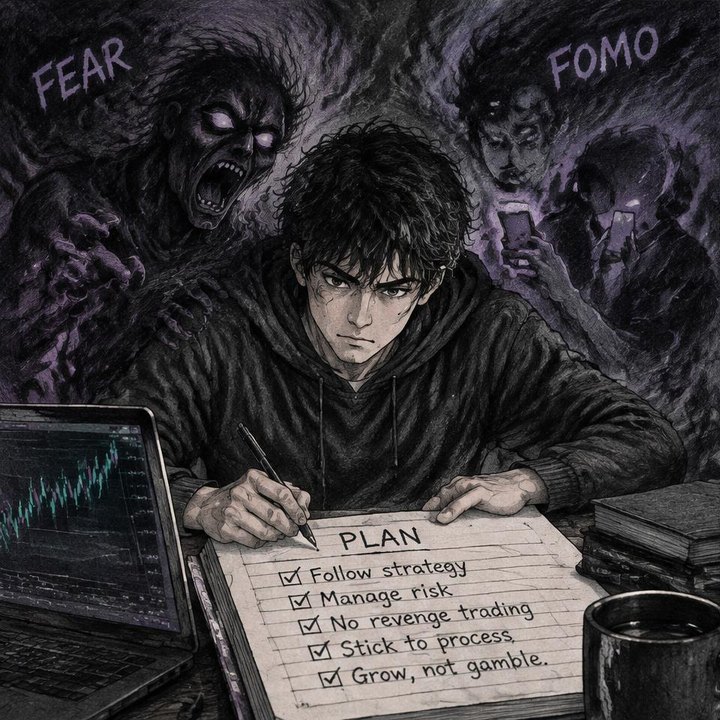
Trading psychology for beginners means learning to manage fear and FOMO with clear rules, rather than trying to eliminate emotion. It helps new traders make more consistent decisions before, during, and after a trade. Trading discipline is the ability to follow a tested plan even when outcomes disappoint you. The goal is emotional control over your actions—not certainty about what the market will do next.
What trading psychology is—and what it cannot fix
Trading psychology is the way your thoughts, feelings, and habits influence trading decisions. Beginners often concentrate on indicators and chart patterns while overlooking how differently they behave once money is at risk.
Fear can make you hesitate at a planned entry or exit because a normal price movement feels uncomfortable. Excitement can make you increase your position after a winning trade. Frustration can push you into another trade simply to recover a loss.
These reactions matter, but psychology is not a secret guarantee of success. Losses can also come from an ineffective strategy, trading costs, poor risk management, or changing market conditions. Perfect discipline cannot make a weak strategy profitable.
Trading is a game of probability, not certainty. A setup is a defined set of conditions that may offer an opportunity; it is not a promise. One loss does not prove your method is broken, just as one win does not prove it works.
Your task is to separate the quality of your decision from its immediate result.
How fear and FOMO show up on a chart
Imagine price approaching the prior day’s high, a level you marked before trading. Your plan requires a break above that level and a subsequent pullback that holds above it.
As price rises, fear in trading can take two forms. You might avoid the entry even after your conditions appear because you remember a recent loss. Or you might enter correctly, then close the trade during a small pullback even though your exit condition has not occurred.
FOMO pulls in the opposite direction. Price accelerates, someone posts a winning trade, and waiting suddenly feels unbearable. You buy before the pullback because you worry the opportunity will disappear.
This is the pattern often called FOMO trading: urgency replaces the entry conditions you originally chose. It can also happen without social media. Watching a fast-moving chart is sometimes enough.
Chasing can leave your entry farther from the point where your trade idea becomes invalid. Keeping the same position size may then expose you to more loss than planned.
A chart cannot tell you whether you feel anxious. It can, however, provide observable conditions against which to check your decisions. Ask: “Has my setup changed, or has only my comfort level changed?”
A worked example: waiting instead of chasing
Consider a beginner watching that break above the prior day’s high. Before the move, they write down a simple practice plan:
- Wait for price to break above the marked level.
- Look for a pullback that holds above it under predefined rules.
- Enter only when the planned confirmation appears.
- Place the protective exit where the setup would no longer be valid.
- Choose a position size that keeps the planned loss within their risk limit.
Price breaks higher but does not immediately pull back. The beginner feels an urge to enter because the move looks strong.
Instead, they record “afraid of missing the move” in their journal and leave the order unplaced. Price eventually returns toward the marked level.
Two outcomes are possible. The pullback may meet the written conditions, allowing a planned entry. Alternatively, price may fall back below the level, leaving no valid setup. If price never returns, the trader misses the move.
Missing an unplanned trade is not a rule violation.
Suppose the conditions are met, the trader enters, and the protective exit is later triggered. That is still a planned loss, not necessarily a bad decision. The trader should review execution and the setup without immediately changing the entire method.
Protective orders do not guarantee an exact exit price. Fast markets, gaps, and limited liquidity can produce a worse fill than expected. Planning risk means acknowledging those limitations.
Building discipline before emotions take over
Trading discipline is easier when decisions are made before a position creates pressure. A useful plan defines what you trade, what qualifies as an entry, what invalidates the idea, and when you stop trading.
Replace vague instructions such as “exit if it looks weak” with conditions you can observe. These might involve a marked chart level or another clearly defined rule that you have practised.
If your rule says to exit at a predefined loss threshold, follow it rather than waiting hopefully for a recovery. Do not move a protective exit farther away simply because accepting the loss feels painful.
Position sizing matters, too. If a routine price fluctuation makes you unable to follow your plan, your exposure may exceed what you can realistically tolerate. Practising in simulation or reviewing smaller exposure can help you assess that mismatch. Simulation, however, does not fully reproduce the pressure of risking real money.
Discipline does not mean following a strategy forever without questioning it. It means separating execution from evaluation: follow valid rules during the session, then assess them during a scheduled review.
Common mistakes—and what to record in your journal
A trading journal is your best practical tool for uncovering emotional biases. Record more than whether you made or lost money. Include the setup, intended entry and exit, position size, actual execution, emotions, and any rule deviations.
Watch for these common mistakes:
- Exiting to relieve anxiety: Record whether the exit followed your plan or merely reduced discomfort.
- Chasing after someone else’s win: Note what triggered the urgency and which entry condition you skipped.
- Revenge trading: After a loss, notice whether your next trade has a valid setup or only a desire to recover.
- Increasing risk after a win: Confidence is not evidence that the next trade deserves more exposure.
- Judging decisions only by profit: An impulsive winner can reinforce a dangerous habit. A planned loss can reflect sound execution.
During review, look for repeated patterns rather than drawing conclusions from one trade. Do rushed entries follow social media checks? Do you abandon exits when tired? Turn each recurring problem into a specific rule you can practise.
A short practice checklist for your next session
Use this routine in chart replay or simulation before relying on it with real money:
- Mark the relevant chart levels and describe your setup.
- Write down entry conditions, invalidation, and exit rules.
- Define your risk limit and a condition for ending the session.
- Name your current emotion without treating it as an instruction.
- Skip trades that fail your checklist.
- Journal your execution and review it after the session.
If you want to learn trading free, start with the free trading course. When choosing the best website to learn trading for your needs, prioritise clear explanations, risk education, and structured practice over promises of easy profits.
Likewise, the best trading coach for a beginner should help build an independent process—not promise certainty. For further mindset and process support, explore Alpha Club or 1-on-1 Mastery.
Keep learning with Trade Feeld. This article is education only, not financial advice. Progress starts with managing your behaviour, not predicting every move.
Follow Trade Feeld
Frequently asked questions
Sources & further reading
Educational content only, not financial advice. Trading involves risk of loss.
Trade these setups live
Get the same signals our research desk uses — entries, stops, and targets in real time.
Gain instant accessKeep reading
Start Trading from 0: The Complete First-Week Plan
Learn how to start trading from scratch with this structured 7-day action plan covering platforms, charts, and your first demo trades.
Trading from 0 to Hero: The Realistic Roadmap
Discover the stages of a trader's evolution, from the initial 'unconscious incompetence' to becoming a consistently profitable market participant.
Comments(0)
Discuss the article and share your tips.