
NFP Day Playbook: Trading the Jobs Report
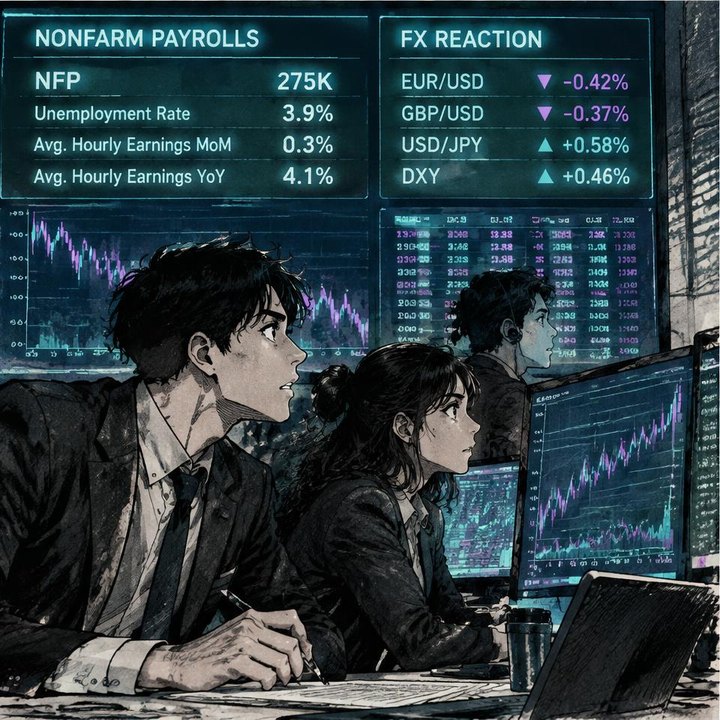
Trading Non-Farm Payrolls (NFP) means reading the whole US jobs report, judging how it changes expectations for Fed policy, and waiting for price to confirm a setup rather than chasing the first spike. This playbook helps intermediate forex, indices, and gold traders prepare for the release, interpret conflicting employment signals, and manage the execution risks that make NFP day different from an ordinary trading session.
What NFP measures and why it matters
NFP measures the net monthly change in US nonfarm payroll employment: jobs added minus jobs lost. It excludes farming and certain other categories, including private household workers and the self-employed. It counts payroll jobs, not unique people, so someone with multiple payroll jobs can appear more than once.
The Bureau of Labor Statistics publishes the figure in its monthly Employment Situation report, usually on the first Friday of the month. Check the economic calendar for the confirmed release schedule and your local time; holidays and scheduling changes can affect publication.
Employment matters because consumer spending accounts for a large share of US economic activity. Job creation supports household income and demand, while persistent job losses can signal weakening growth.
For traders, however, the surprise matters more than whether the number looks strong in isolation. Markets compare the release with consensus forecasts, previous readings, and the economic story already reflected in prices. A healthy headline can disappoint if investors expected something stronger.
Read the three pillars together
The jobs report contains three headline signals, plus revisions that can change their meaning.
- Non-Farm Payrolls: The net change in payroll jobs. A result above expectations can support the dollar, particularly when it reduces expectations for interest-rate cuts.
- Unemployment rate: The share of the labor force without a job who are available for work and actively seeking employment. It comes from a household survey, while payroll employment comes from an establishment survey.
- Average hourly earnings: A measure of average pay on covered private nonfarm payrolls. Traders watch wage growth for clues about income, demand, and inflation pressure.
Because the surveys measure different things, payroll growth and unemployment can move higher together. More people entering the labor force can lift unemployment if some have not yet found work, even while employers add jobs.
Average hourly earnings also needs context. Faster wage growth can complicate the inflation outlook, but wages do not translate mechanically into consumer-price increases. Changes in the mix of higher- and lower-paid jobs can affect the average.
Finally, read revisions to previous payroll reports. A headline beat accompanied by downward revisions may describe a less robust labor market than the initial number suggests.
How the release travels through real markets
The main transmission channel is the expected path of interest rates. A strong labor market can give the Federal Reserve more room to raise rates or maintain restrictive policy if inflation remains a concern. Softer employment can strengthen the case for easing, although no single report determines Fed policy.
Watch how that interpretation appears across markets:
- Forex: Stronger-than-expected employment can lift US yields and support the dollar. EUR/USD may fall, while USD/JPY may rise, but foreign rate expectations and risk sentiment also matter.
- Gold: Rising real yields and a stronger dollar can pressure gold, which pays no interest. Falling yields can support it. Safe-haven demand can interrupt either relationship.
- Indices: Strong hiring can support earnings expectations, yet higher expected rates can weigh on valuations. This is the “good news is bad news” pattern. Conversely, weak employment can hurt stocks if recession fears outweigh hopes for rate cuts.
On a chart, mark the prior day’s high and low, nearby support and resistance, and the pre-release range. Then observe whether price holds outside those boundaries or quickly returns inside them.
NFP’s famous whipsaw occurs when an initial surge reverses sharply. Conflicting data, positioning, reduced liquidity, and changing interpretations can all contribute. Algorithms may react immediately, but sophisticated systems process more than the headline; the sequence is not simply machines first and humans second.
The guidance for Alpha Club members is to wait at least 15 minutes before considering an NFP trade. Treat that as a discipline rule, not a guarantee that volatility has settled.
Worked example: a headline beat that fails
Consider a hypothetical report where payroll growth exceeds expectations, but the unemployment rate rises, average hourly earnings soften, and earlier payroll gains are revised lower.
The dollar initially jumps. EUR/USD breaks below the prior day’s low, while gold drops through nearby support. Someone reading only the headline might assume the moves will continue.
Next, the broader interpretation changes. Traders question whether the report really supports tighter monetary policy. US yields give back their initial rise. EUR/USD returns above the broken low, and gold recovers its lost support.
For an educational chart exercise, separate two possible setups:
- Continuation: EUR/USD stays below the prior day’s low, then retests that level from underneath and fails to reclaim it. This is consistent with continued dollar strength.
- Failed breakout: EUR/USD reclaims the low, holds above it on a retest, and begins forming higher lows. The initial bearish breakout has failed, though that alone does not guarantee a sustained rally.
Before either simulated entry, define what would invalidate the setup. A stop belongs beyond a meaningful invalidation level, with position size adjusted to the distance. If the next opposing level leaves insufficient room relative to the risk, skipping the trade is a valid outcome.
Common mistakes on NFP day
Trading the headline alone. Read unemployment, wages, and revisions before deciding what the release implies.
Assuming the usual market relationship must hold. Strong NFP is not automatically bullish for the dollar or bearish for gold. Expectations and the current inflation-growth balance shape the response.
Confusing volatility with opportunity. Wide spreads and thin liquidity can make an attractive chart difficult to execute. Stop orders may fill worse than intended, and a limit order may not fill at all.
Widening stops without reducing size. A wider stop increases planned monetary risk unless position size falls. Even then, slippage can push the realized loss beyond the planned amount.
Treating historical ranges as forecasts. The “Historical NFP Range” in the Trade Feeld Terminal provides context for how instruments such as EUR/USD or the S&P 500 have moved around previous releases. Check its measurement window. Use it to assess whether your assumptions are realistic, not to predict a guaranteed range or choose a stop mechanically.
Forcing a trade after waiting. Fifteen minutes passing does not create an edge. Mixed signals, unstable spreads, or unclear structure remain reasons to stay out.
A short NFP practice checklist
Use replay or a demo environment to rehearse the process:
- Confirm the release time, forecasts, and previous readings.
- Mark key chart levels and write conditional strong, weak, and mixed-report scenarios.
- Record payrolls, unemployment, earnings, and revisions together.
- Compare the dollar, yields, gold, and indices for confirmation or disagreement.
- Wait for usable spreads and a clear continuation or failed-breakout structure.
- Define invalidation, position size, and acceptable execution risk before a simulated entry.
- Review whether your interpretation and execution followed the plan, not just whether price moved your way.
If you want to learn trading free, prioritize structured practice over signal chasing. The best website to learn trading should help you build a repeatable process, understand uncertainty, and review mistakes—not promise easy NFP profits. This playbook is education only, not financial advice.
Follow Trade Feeld
Frequently asked questions
Sources & further reading
Educational content only, not financial advice. Trading involves risk of loss.
Trade these setups live
Get the same signals our research desk uses — entries, stops, and targets in real time.
Gain instant accessKeep reading
How Companies Actually Make Money: The Core of Fundamental Analysis
Understanding the primary revenue models and cost structures that drive corporate profitability is the first step in fundamental analysis.
What Are Financial Statements? A Beginner's Guide to Corporate Data
Financial statements are the official records of a company's financial activities, providing a snapshot of its health and performance.
Comments(0)
Discuss the article and share your tips.